
Manual metal etching - the simple alternative
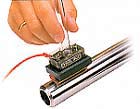
If your product needs high-quality permanent marking, but you cannot justify the expense of a laser-marking system, or dont need a semi-automatic ething system- then the manual metal-etching systems are the ideal solution for you.
The manual electrolytic etching method simply involves postioning your stencil in the desired location and pressing the marking head onto stencil to make a contact with the part. The electrolyte transfers the controlled low-voltage current through the gaps in the stencil and etches into the material to leave a mark in a few seconds!
Suitable for a wide range of products
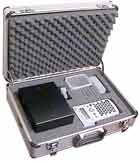
The manual etching method is suitable for a wide range of products, from small items such as surgica instruments in hospitals to large assemblies in engineering workshops.
Units can be mounted on mobile trolleys to be moved to the job (we can even extend the leads for your convenience) or can be supplied in a suitcase!
The type of etching control unit required will be determined mainly by the size of the mark required but also by the material being marked and the production volume.
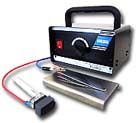
MINIETCH EU80
Suitable for small marks and low production only. Analogue adjustment and "blackmarking" capability only.
| Input voltage | 115 or 230 V, AC |
|---|---|
| Output voltage | 8 V, 16 V or 24 V (AC) |
| Power | 80 VA |
| Dimensions (H x W x D) | 155 x 200 x 150 mm |
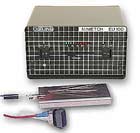
MINIETCH EU100
Suitable for small and some medium marks and medium production only. Slightly higher power than the EU80. More "finetuning" adjustment and both black-marking and deep-etching capability.
| Input voltage | 115 or 230 V, AC |
|---|---|
| Output voltage | 0 - 24 V (AC/DC) |
| Power | 100 VA |
| Dimensions (H x W x D) | 155 x 200 x 150 mm |
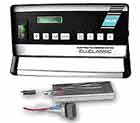
EU CLASSIC 300
Fully digital control for medium & some large marks in a medium-high volume production environment (both black-marking and deep-etching functions) . More consistent logo marking due to much higher power and additional timer function (activated via footswitch)
| Input voltage | 115 or 230 V, AC |
|---|---|
| Output voltage | 0 - 30 V (AC/DC) |
| Power | 310 VA |
| Dimensions (H x W x D) | 140 x 380 x 220 mm |
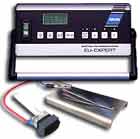
EU CLASSIC 500
Increased power for better etching of large marks and faster marking of medium marks. More consistent logo marking due to much higher power and additional timer function (activated via footswitch)
| Input voltage | 115 or 230 V, AC |
|---|---|
| Output voltage | 0 - 30 V (AC/DC) |
| Power | 510 VA |
| Dimensions (H x W x D) | 140 x 380 x 220 mm |
See also:
Metal Etching overview | Semi-automatic metal etchers | Surgical Instrument Etching